Spoiler Review is a new series where I will review movies that require many spoilers in order to review them properly. This is my review of "Gravity." This goes without saying: SPOILER ALERT.
Every time a movie comes out that uses 3D really well, like really really well, I never hesitate to call it the second coming of cinema. "Avatar." "Hugo." "Life of Pi." Yes, I do strongly regret giving "Avatar" that much credit.
I don't want to say "Gravity" has changed the game. It's just responded to the tools of our time so well and it has done what many others only wished they could accomplish. More importantly, if you ever doubted that the wonder of the movies has been stolen by TV, then look at "Gravity," and you'll understand that it never went anywhere.
Showing posts with label 3D. Show all posts
Monday, October 7, 2013
Sunday, October 6, 2013
Movie Review: Gravity
"In space, no one can hear you scream."
This is now the famous tagline from "Alien," and the basis for "Gravity." "Gravity" hasn't been advertised as a horror film, but it captures the fear of being alone in space better than most others that have tried way too hard to do so.
"Gravity" marks the long awaited return of Alfonso Cuaron who last directed "Children of Men," which is still one of my favorite films of all time. Like "Children of Men," there is no indication of when the camera starts and stops rolling. Cuaron is one for relentless action. Immersive might not even be a strong enough word to describe "Gravity." I get the feeling that Cuaron just wanted us to float in space with him forever. There were multiple times where I felt short of breath. Apparently, you don't need any dimensions beyond 3D to get all your senses this invested in a movie.
This is now the famous tagline from "Alien," and the basis for "Gravity." "Gravity" hasn't been advertised as a horror film, but it captures the fear of being alone in space better than most others that have tried way too hard to do so.
"Gravity" marks the long awaited return of Alfonso Cuaron who last directed "Children of Men," which is still one of my favorite films of all time. Like "Children of Men," there is no indication of when the camera starts and stops rolling. Cuaron is one for relentless action. Immersive might not even be a strong enough word to describe "Gravity." I get the feeling that Cuaron just wanted us to float in space with him forever. There were multiple times where I felt short of breath. Apparently, you don't need any dimensions beyond 3D to get all your senses this invested in a movie.
Saturday, July 7, 2012
Movie Review: The Amazing Spider-Man
After the disaster of "Spider-Man 3," which all but destroyed the hero that made superheroes box office gold, the world wasn't exactly craving more Spider-Man. "The Amazing Spider-Man" isn't the superhero movie we needed, but we got it, and it's actually a stellar installment of the myth of a man in red spandex.
To compare "The Amazing Spider-Man" with Sam Raimi's "Spider-Man" is to tiptoe on a tightrope, as saying that the new one is better than the old one would be potentially putting down something that I deeply cherish. "Spider-Man" was one of the first movies I watched multiple days in a row when it first arrived on DVD, and it spurred an interest in comic books that led me to a giant box full of them in the attic (benefits of having an older brother). But then again, what makes "The Amazing Spider-Man" work is its ability to build on and improve the flaws of its predecessors.
Friday, June 8, 2012
Movie Review: Prometheus
![]() |
| Look familiar at all? |
Ridley
Scott's "Prometheus" is like a sci-fi opus from a better time in the
history of sci-fi films. And I would know, because I like to pretend I grew up
then.
"Prometheus"
rises above because for once, it is a movie interested in actually exploring
what lies in space, as opposed to just killing everything not from our home
planet. If you give Ridley Scott a space ship and weird space creatures that
like to impregnate people, he will create his best work. Basically, he needs to
stay out of Medieval England and French vineyards.
Saturday, November 26, 2011
Movie Review: Hugo
Even this late in his career, Martin Scorsese can still reinvent himself, even if it means not changing at all. "Hugo," based on the award-winning children's book "The Invention of Hugo Cabret" by Brian Selznick, is the rare PG-rated Scorsese film. However, that does not make it a children's movie as many have labeled it. "Hugo" is for everyone.
"Hugo" is mechanical, yet magical. In the early 1930s, Hugo (Asa Butterfield) lives inside the walls of a Parisian train station, operating all of the station's clocks. He has been doing this ever since his father (Jude Law) died and left him as an orphan. His life inside the walls gives him an innate ability to sneak around totally undetected. He steals in order to get by, which puts him at constant odds with the scheming and ill-tempered station inspector (Sacha Baron Cohen). As the inspector, Cohen looks like a more over-the-top version of Charles De Gaulle.
All that Hugo has left of his father is a broken automaton which he spends his spare time trying to fix. He steals parts from, and eventually gets caught by, George Melies (Ben Kingsley). That name doesn't mean a lot to young Hugo at first, but he later discovers that he is none other than the legendary pioneer of filmmaking himself. Melies was one of the first filmmakers to figure out that moving pictures could tell stories.

"Hugo" is based on a book and its about the power of imagination, but it is also about Scorsese's love of movies. At one point, Hugo takes of Melies's daughter Isabelle (Chloe Grace Moretz) to see a movie in order to cheer her up. He believes that the movie theater is the only place where he can escape from reality. Viewers will also be treated to a history of film as well as footage from several key movies of the silent era. "Hugo" is a film buff's dream come true.
From looking at the early movies shown in "Hugo," there really was magic in them. The less realistic the special effects were, the more creative and deceptive filmmakers could be. Melies was equal parts filmmaker and magician.
Early silent films involved many tricks to feign depth and perspective. "Hugo" itself attempts this, and it contains some of the best 3D there has ever been. The third dimension is usually wasted by those who don't understand the potential of it. In "Hugo," 3D is not a gimmick but rather a way to add a layer of physical depth, and make this complex world of mazes and winding staircases even more immersive. I am not a cheerleader for the cause of 3D. However, if more directors used 3D the way Scorsese does here, then perhaps this new trend won't necessarily spell the demise of movies as we know them.
As with any great movie, none of the special effects would mean anything if they did not support a great story. "Hugo" is an uplifting fantasy that is also very real. It balances out its darkest moments with comedy. Best of all, "Hugo" is not just about Hugo. The longer the audience spends in the train station, the more it gets to know the characters that occupy it. The subplots involving the inspector's attempt to woo the flower shop owner (Emily Mortimer) and another including an old man at odds with a small dog are entertaining and actually tie in with the story as a whole. These segments of "Hugo" reminded me of the subplots seen in the windows of the apartment complex in "Rear Window." Neither of these movies would be able to function without their settings, or the variety of people who occupy them.
The latter part of Scorsese's career has been a mixed bag. While he won his first Oscar in 2006 for "The Departed," few of his latest efforts have matched the brilliance of his earlier efforts. "Hugo" is his finest achievement in years, but there is just no way to compare it to his earlier works. There is nothing wrong with creating something that defies comparison.
Even if no one is shot in the head or shoved into the trunk of a car, "Hugo" could only have been made by Scorsese. His version of Paris transforms the City of Lights into something much grittier. The Paris of "Hugo" looks more like New York via "Gangs of New York": snowbound, destitute, and industrial. Then there is Hugo's world, which is one marked only by turning gears, with the great city surrounding him being just outside his reach. The only light of hope that ever shines is from a film projector.

In a way, Hugo is Scorsese in his youth. During his childhood on the mean streets of Little Italy, the movies were his only means of escape. Even as time passes, movies will always remain. The fact that "Hugo" is about a young boy saving the lost films of a once great artist is the kind of warm, moving act that doesn't usually occur in a movie directed by Martin Scorsese. Even though "Hugo" claims that humans are just parts of the larger machine of the world, that can't explain the feeling of being moved to tears by the movie's end.
There is a scene in "Hugo" where Hugo and Isabelle watch "A Trip to the Moon" for the first time, and learn that each frame was colorized individually by hand. In the present, a camera can do that, and a computer can create any special effect imaginable. Therefore, it is hard for any movie made today to ever feel hand-crafted. When as much care, love, and devotion goes into making something like "Hugo," it is then that the director's, and not a computer's, fingerprints are all over it. This is one of the best movies of the year.

As a side note, has anyone noticed that whenever a major movie is released that takes places in a foreign country but is spoken in English, all of the characters have British accents? When will Hollywood get that people can tell the difference between a French accent and a British accent?
Here are links to some of the silent movies featured in "Hugo":
The Great Train Robbery (There is an allusion to the final shot at the end of "Goodfellas")
Labels:
3D,
Ben Kingsley,
Chloe Grace Moretz,
Emily Mortimer,
French,
Georges Melies,
Hugo,
Jude Law,
Martin Scorsese,
Movie Review,
Paris,
Sacha Baron Cohen,
Silent Film,
The Invention of Hugo Cabret
Monday, August 22, 2011
Summer 2011: In Which Woody Allen Saves Hollywood
Summer is the season that studios are supposed to provide audiences with movies that provide unforgettable entertainment. In the past, this season has given us "Jaws" and "Star Wars." Gone are those great days. In the outside world, it was one of the hottest summers on records. In cinemas across the country, it was one of the most miserable. The summer of 2011 was the summer in which 3D killed itself along with good storytelling, with few notable exceptions. Woody Allen's "Midnight in Paris," without even meaning to be, became everything that the summer movie should be: wise and whimsical escapism. It is the most memorable movie he has made in years, and one that deserves to be mentioned in the same breath as "Annie Hall" and "Hannah and Her Sisters."
Summer movies are all about creating a spectacle and the site of 1920s Paris is a spectacle, albeit one that didn't cost $300 million to shoot."Midnight in Paris" is Allen's return to his anti-intellectualism roots. Some scenes are about as good as the Marshall McLuhan scene from "Annie Hall." Plus, Owen Wilson is the most convincing Woody Allen stand-in to grace the screen thus far.
Before getting to the mediocre, it is necessary to acknowledge the good. Most of the best summer movies were definitely not saved for last. "Bridesmaids" was not the groundbreaking triumph in the women's rights movement as some suggested, but simply a near-perfect comedy. "Bridesmaids" works because of its playful anti-romantic comedy feel that's sometimes nasty but never really mean. In other words, it loves every single one of its characters. All of the dialogue and situations flow with the awkward and unforced feel of reality. One of the most underrated masters of awkward comedy (Paul Feig) got his moment in the sun. And the star and co-writer, Kristen Wiig, has gone from "Saturday Night Live" skit saver to bankable Hollywood actress. Sometimes, success in Hollywood can be well deserved.

Also at summer's beginning was the superb "The Tree of Life." It was a head scratcher, but more in the "2001: A Space Odyssey" sense. At this point in his career, Terrence Malick has earned the right to tell a story that jumps back and forth between the creation of the universe, 1950s Texas, and dinosaurs. Even in their shortest moments, those family scenes felt so real. It was never meant to create a complete portrait of their lives, but it is rather the story of how our memories, and our very existences, fit in to the universe as a whole. In the whole scheme of things, does it really matter how we live our lives? That is a question, along with many others that Malick raises, that countless people will explore for years to come.
The great thing about a film about "The Tree of Life" is that it didn't pander to its audience in order to make something that they want. Sometimes, the best directors make different and difficult movies because sometimes, those are the movies we ought to be seeing more of. Unfortunately, some filmmakers don't seem to realize that, and that plays a part in this mediocre summer. I didn't see "Transformers 3" or "Green Lantern" or "Thor," so I can't speak for any of those movies. However, I did see "Super 8." While it was a highly entertaining and superbly made piece of 70s nostalgia throughout, its ending reversed all its progress. It is great that J.J. Abrams took his time on his film and didn't reveal the monster instantaneously. However, its ending resolved every plot line too quickly and too easily and what should have been thrilling came out as dull.
"Horrible Bosses" also missed the mark just slightly. While its three leads (Jason Bateman, Jason Sudekis, Charlie Day) pulled off three of the best comedic performances I've seen in years, a certain part of the story involving a navigation system turned the film into a sellout. The characters get themselves into some pretty terrible situations thanks to their stupidity, but letting them off the hook that easily doesn't seem fair to anyone. Despite that, Bateman can still deliver a punchline with flawless deadpan, and Day can seem innocently insane even when he's not parading cats with mittens around.

In the end though, 2011 can be defined as "The Summer of Meh." This is not the state of an angry reaction, but rather an uncaring one. I could talk about how terrible "Cowboys & Aliens" is but nothing about that movie really motivates me to. "Midnight in Paris" was the rare film that deserved to be seen by a wide audience and with a little patience, it was. "Terri" is probably going to go on my year end list, but it won't be in a theater near you anytime ever.
This summer, movies lost their mojo. Hopefully, Hollywood will take this as a learn from their mistakes rather than ignore them, as they always do. Perhaps superhero movies and shoddy 3D are on the way out. While it is understandable that story doesn't always get people in the theater, it should go without saying that the audience enjoy the product they are paying to see. Luckily, the fall and winter seasons look promising ("Moneyball" and "The Girl with the Dragon Tattoo," particularly). For now, just enjoy some of the fine programming cable television has had to offer this summer. For instance, have you watched "Breaking Bad" yet?

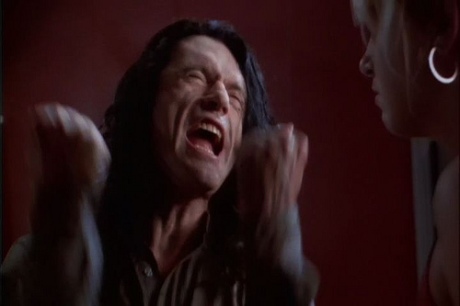
This is one of the funniest still images from a movie ever. Why isn't this a meme yet?
Tuesday, December 21, 2010
Tommy Wiseau: Persistence is Everything
Tommy Wiseau is the auteur no one ever asked for, and the one no one ever wants to go away. Not because he actually displays any sort of artistic merit, but because he is just always here. For those of you unfamiliar, Tommy Wiseau came out of nowhere and released a movie called "The Room." Like any enduring cinematic classic, "The Room" was largely ignored upon initial release. Years later, it gained much popularity and a huge cult following once audiences started to realize it was one of the most awful, laughably implausible movies ever made.
"The Room" looks like it was shot for six dollars, despite having a budget of $6 million, and the dialogue sounds like it was created by someone who does not have any understanding at all of the English language.
Today, "Room" lovers were given another reason to live: Wiseau plans to release "The Room" in 3D. Yes, that means the horrifyingly long sex scenes will be given an extra dimension. Here's an upgrade no one asked for, but we will (somewhat) thankfully be receiving. Wiseau also plans to release the film in Blu-Ray. To that he might say, "oh, hi technology!"
Now, as someone who has openly railed against 3D on various occasions, I am strangely excited for this. As an unapologetic "Room" fan, I am always excited to see what shocking heights of awfulness Wiseau is capable of. We saw another glance of what other possible stories he could produce, when the vampire short film "The House that Drips Blood on Alex" was released online earlier this year.
Not only will "The Room" be treated to two new formats, but Wiseau also plans to release a clothing line. That's right; he's even taking over the garment industry now. I have a good feeling that the 3D won't look so great, the Blu-Ray features will just make the movie even more confusing, and his clothes will likely lack a basic necessity like buttons, or fabric.
Yet, despite the complete lack of talent, it is almost impossible to ever hate this man. Why? Because when the world tells him he's as bad as Ed Wood, he doesn't back down. When people tell him he can't speak English, he just keeps speaking. He will never give up his unique, eccentric personality. There is nothing Tommy Wiseau can't do right, but that doesn't mean he is going to ever stop doing it. And that is why "The Room" is a cinematic masterpiece, and Tommy Wiseau is its auteur. Bring on the 3D.

For More Information on Wiseau's Latest Developments, Read On
And of course...
Friday, June 18, 2010
Movie Review: Toy Story 3
How rare it is to find a sequel that's not looking to sell a new toy line, or even another three sequels. How nice it is when a sequel would rather continue telling a story, than capitalize off of it. That rare day has come with "Toy Story 3." Then again, this should've been expected by this point. Pixar cemented its status as the greatest animation creator since Walt Disney years ago and they proved they could handle sequels when "Toy Story 2" was released 11 years ago.
Rather than start directly where it last left off, "Toy Story 3" takes place in the present day. Andy is now 18 and heading off to college. He hasn't played with any of his toys in years. While he means to keep them stored in the attic, the toys end up being donated to a day care center by accident. What seems at first like paradise with a benevolent bunch of toys, including Lotso (Ned Beatty) and Ken (Michael Keaton), turns into a living hell for deserted toys. The mission, once again, is to get back to Andy.
Despite being locked up in a chest for years, the toys haven't changed at all. Woody (Tom Hanks) remains the most loyal friend in the world. Buzz (Tim Allen) still believes he's a real space cadet. Jesse, Mr. and Mrs. Potato Head, Rex, Hamm, and even the little red monkeys, are all still there. And let the nostalgia begin.
When the original "Toy Story" was released in 1995, it ushered in an era of computer animation. It's incredible to see how far the genre has come since then with the characters that started it. By this point, "Toy Story 3" doesn't even look like it was created on a computer. It might as well have been shot on real Hollywood sets. Well, it might just look even more real than that.
"Toy Story 3" also has the benefit of 3D. That's right, I said benefit. The only other movie I've seen that's benefited from 3D is "Avatar" (the wine cork scene from "The Final Destination" doesn't count). What works with the 3D in "Toy Story 3" is that its not gimmicky. Nothing pops out at you. The characters and settings pop out of the screen organically. If more filmmakers could harness 3D in appropriate ways like this, then I might just hop on board.
"Toy Story 3" certainly doesn't hide behind its visuals. Who needs them with a story this good? The movie might be a slightly basic variation of the first two (toys get lost, toys try to get back from Andy), but that doesn't mean it's not original. Most sequels usually lazily ripoff their predecessors. Pixar is too good for that.
Not only does the story feel fresh, but so does every individual moment. That's another rarity. For example, "Shrek 2" tried to teach important lessons like its predecessor. Yet, they were basically the same as the original, and therefore felt nowhere near as effective. However, every little poignant moment in "Toy Story 3" feels so new.

And once again, Pixar proves it amazing ability to bring human qualities to the nonhuman. Sure, its not too hard to feel sympathetic for a fish, or even a kind rat. But making the audience care for inanimate objects is no easy task. Once again, this task is pulled off perfectly. What we see is that a toy can be just as good a friend as any person.
To classify "Toy Story 3" as a kids' movie would be a gross inaccuracy. It is a family movie, meaning any member of a family, at any age, will get something out of this movie. Children will learn the value of friendship and commitment. They will also get an exciting story. Teens and adults might even get a more enriched experience. Some of the humor involves a keen sense of observation, and some film knowledge (spot the "Cool Hand Luke" reference). This movie should finally teach the haters that animation is not purely kiddie junk.
Now, I'm going to do something I don't normally do. Rather than discuss "Toy Story 3" for what makes it such a great movie, I'm going to discuss what this movie means to me. The "Toy Story" series will always hold a special place in my heart, and this sequel certified it. How amazing it is that the creators coincided Andy's life with both the beginning of mine, and my entry into adulthood. Pixar doesn't always deal much with its human characters, but Andy's college angst feels too familiar. "Toy Story 3" made me want to rediscover my childhood.
This also helped make every character even more meaningful to me. There is a moment toward the end, which I obviously won't fully reveal. It was handled so maturely, and it's so dark, that I'm shocked the studio didn't alter it. Yet, it shows us the unbreakable friendship between the toys. After all these years, they're still together. After all these years, I still want to be a part of their journey.
As a friend lamented once the movie ended, "'Toy Story 3' represents the end of my childhood."* Pixar bookmarked the start and end of my childhood. It was one of the first movies I remember seeing, and one of the last ones I'll see before I walk down graduation isle. As the film's conclusion showed, it's not just about the end of one phase of life, but the beginning of a new one. And if this new beginning might also signal more time with Woody, Buzz, and the gang, then count me in.
*Quote attributed to Reverend Doctor Eric H. Wessan
Friday, March 5, 2010
Movie Review: Alice in Wonderland
This is not the Alice you were expecting. Or so we are reminded throughout. This is a new Alice, in a new Wonderland, for better, or for worse. Tim Burton's "Alice in Wonderland" gives you exactly what you'd expect in a Tim Burton film: weirdness, darkness, and madness. Although it misses out on some of the depth of his earlier work, "Alice" shows that this man still understands the concept of the fairytale.
Rather than making this "Alice" exactly like the original, Burton decided to give it a little twist. Thirteen years after first discovering Wonderland, Alice (Mia Wasikowska) is curious teen, totally loathing her dull Victorian lifestyle. As she is proposed to, she follows that same white rabbit with the stop watch and falls down that same rabbit hole. She's back where she's been before but this time, she can't remember a thing.
While in Wonderland, she meets the very mad Mad Hatter (Johnny Depp), who convinces her to team up with the White Queen (Anne Hathaway) and defeat the evil, reigning Red Queen (Helena Bonham Carter) by slaying the Jabberwocky.
To this minute, I still feel split in my thoughts on this film. On the one hand, it was thoroughly entertaining. On the other hand, it's filled with flaws.
My biggest problem with "Alice" was that it felt as if Burton was rushing through the story. Even though Alice has existed for almost 150 years, this is obviously a different Alice than we've seen before. It's apparent that she's a bored free spirit living in the wrong universe. However, barely any background is given as to how she became this way. I thought one of the stronger aspects of "Where the Wild Things Are" (a film I use as a basis of comparison because they are actually very similar) was that it built up all of Max's anger and alienation into this alternate world. He earned his rite of passage into the Land of the Wild Things. Alice should've waited a bit longer.
"Alice in Wonderland" is perhaps the most ambitious experiment in converting a film into 3D. However, this story should've been kept in the second dimension. None of the visuals seem to pop out at you in an "Avatar" way. Seriously, that 3D cat food commercial that ran before the movie started used the technology better. A film that isn't shot in 3D isn't shot in 3D for a reason. Burton was probably trying to keep his vision two dimensional on purpose.
Despite the failed 3D, the set design and cinematography are nothing short of stunning. Burton creates a world that's been seen so many times before in a surprisingly unique way. He tries to turn Wonderland into his own land. Meanwhile, the lush yet dark photography perfectly matches the film's tone.
Rather than going with a known lead to play Alice, Burton went for newcomer Wasikowska. She's a welcome breath of fresh air, and certainly a promising future star. She takes a 19th century character and fills her with relatable, 21st century teenage angst. It's too bad she wasn't given a better script, though. Same goes for Depp. Based on interviews, it's obvious how much amazing work Depp did to portray the Mad Hatter. However, he's given such little time to do his thing. I think with a little less constraint, Depp could've done the same thing with the Mad Hatter that he did with Jack Sparrow in "Pirates of the Caribbean" and Hunter Thompson in "Fear and Loathing in Las Vegas."
I think what this is all leading up to is an unfortunate amount of superficiality. That's disappointing for a director who's brought humanity to both a man with scissors for hands ("Edward Scissorhands") and the guy who directed "Plan 9 from Outer Space" ("Ed Wood"). Burton has always put much effort into the world he creates, but he never abandons the humans that inhabit it. And even here, Burton doesn't seem to relish the wonders that Wonderland provide. You stare, but don't gaze, at it.
I hope I'm not sounding too negative because overall, "Alice in Wonderland" is a good film, but just not the great one that it could've been. "Alice in Wonderland" might give us a new story, and a new Alice, but something about it just doesn't seem inspired enough.
Some Bonus Fun: http://www.youtube.com/watch?v=WANNqr-vcx0
Saturday, December 19, 2009
Movie Review: Avatar
"Avatar" is one of those films that's not just a film, but a vision beyond anyone's wildest dreams; it's daring in ways one couldn't even imagine.
Cameron's strange yet fascinating sci-fi epic takes a few steps to break down, it's a premise that mixes contemporary society with ancient faiths. "Avatar" takes place around the year 2154. At this point, the earth has been totally ravished by humans (and, not mentioned in the movie, run out of oil), so the human race heads toward a distant moon called Pandora. Pandora contains a race of creatures called the Na'vi, a tall, blue species with a cat-like face and human tendencies. More important to humans, the moon also contains a valuable, energy-rich rock called Unobtanium. In order to get the Unobtanium, humans infiltrate and then hope to destroy the Na'vi by slipping into their bodies in Na'vi form. These bodies are called Avatars.
War veteran Jake Sully (Sam Worthington), paralyzed from the waist down, takes his brother's place on Pandora after he dies. He is sent to become part of the Na'vi, but in the process, he becomes a powerful member of the tribe, and falls in love with a Na'vi woman (Zoe Saldana).
In some ways, in different hands "Avatar" could have been a disaster, or maybe just an action film like any other action film ever made. But in the hands of a man with a real vision, "Avatar" is something totally different. "Avatar" is shot with a new form of Motion Capture technology that Cameron himself invented. This form looks stunningly real, from the monsters that live on Pandora, to the Na'vi themselves. While some forms of Motion Capture come out as uncannily unrealistic, there is something about the Na'vi that is incredibly human.
The film is shown in 3-D, a usually wasteful tool to add to feature length films. It is something I usually associate with the Muppet ride at Disney World. When used in most films, the only thing it is used for is to shoot raindrops or bullets out at the audience. "Avatar," however, uses its 3-D to make its images more stunning. It seems like more of a way to put the viewer into the film than create some means of shock value. While I hope 3-D doesn't become a regular feature in filmmaking, if it is used for this purpose alone, then I really wouldn't mind.
The storyline of "Avatar" has many elements derived from both contemporary issues and religions. This helps turn the film into a pretty effective parable of human nature in both the past and the present. For example, Avatar comes from the Hindu faith and is the manifestation of a deity from heaven to earth. That makes sense, as Avatars are humans in Na'vi form. Also, the entire film itself seems based off the Hindu belief of reincarnation, as the wheel-chaired Jake wants so desperately to be reborn into something else.
The film also seems to take on the totally unrelated ideology of Shinto, in which it is thought that people have a spiritual connection with the natural world, a connection the Na'vi share with their own planet.
When looking at "Avatar" from a contemporary perspective, one could quite obviously point out that it is a highly critical look at man's depletion of his own home. Some might even try and politicize the film for this reason, though politics should be left out of it.
Looking deeper into the film, one could see that it is about the horrors of imperialism. The war between the humans and the Na'vi often mirrors the destruction of the Native Americans of the United States or the Aztecs in Central America. It is also about the human instinct to act as pillagers: destroying one land, and then moving on to the next.
Moving beyond the themes, the greatest part about "Avatar" is its incredible CGI. Pandora becomes a planet that seems almost tangible. Every aspect of it, from the animals to the plants to the water, is something that could never have been thought of by anyone. In this light, one could almost say "Avatar" is the "Star Wars" of this generation that we've all been waiting for.
Alas, "Avatar" doesn't go without its minor flaws. At times, some of the dialogue is a little clunky. Also, the basic storyline is one that has been done before in one way or another. However, the context it is put into is totally original.
Quite simply "Avatar" is such a great filmgoing experience because its audacious, and its exciting. The end battle sequence is one that could rival the ones from "The Return of the King" and "Lawrence of Arabia."
The very first line of "Avatar" is, "You're not in Kansas anymore!" This shows that in "Avatar," you're being swept out of your comfort zone and being taken to a place beyond the imagination. It could also be nothing less than a shout out to "The Wizard of Oz," a film that led the way to a new dimension of filmmaking with its bold use of color. Cameron is the kind of filmmaker with the vision to accomplish this.
Cameron always manages to defy our expectations. People doubted him before "Titanic" came out and they did the same with "Avatar." Both times he totally changed the game. As Pandora was the beginning of a new frontier for humans, "Avatar" is the beginning of a new frontier for filmmakers worldwide.
Note: Earlier, I accidentally wrote that Pandora was a planet, when it is in fact, a moon. We all make mistakes sometimes, and for this one, I apologize. Thanks to Cameron Bruce for catching this mistake.
Friday, August 28, 2009
Movie Review: The Final Destination (3D)
When did audiences stop caring about life and start cheering on merciless, unnecessary death? I didn't realize this was the case until I sat through "The Final Destination." In 3D. And felt myself cheering too. Maybe it wasn't such a bad thing that we were all cheering. After all, what sympathy could be felt for the characters? Not one felt the least bit developed. Well, maybe a little bit. The most I could say is that Nick (Bobby Campo) goes to a race car event with his friends. There, he has premonitions of a disaster in the stadium causing brutal death. Him and his friends, along with a few others, narrowly escape the carnage. They have cheated death. This sets off a chain of events that leads to each of them being killed off in the most unpleasant ways imaginable. Oh, and Nick also has a friend named Hunt (Nick Zano) who's kind of a tool. I don't remember any other of the characters' names. And I don't really care.
The actors certainly don't help bring sympathy to the characters. Their dull and lifeless delivery bring nothing to the script; not that there's anything good to the script. The dialogue is nothing but a series of platitudes and cliches. At one point, one character actually says "you only live once" and tries to pass it off as original, moving, and insightful. Of course, it is none of these things.
The film's director, David R. Ellis, has a strange resume that includes "Final Destination II," "Snakes on a Plane," and "Homeward Bound II." In directing "The Final Destination" he breaks the rule that makes a horror film great: waiting. Don't try to hit your audience with so much in so little time, you have to let the characters grow. You have to let the fear grow. That's what makes horror films like "Psycho," "The Silence of the Lambs," and "Carrie" so effective: they grow on you. And then, suddenly, they give you and incredible jolt out of the dark.
The debate "The Final Destination" covers is one that has been argued for centuries on and off the screen: fate vs. freewill. Can you cheat death? And if so, will death find you again? "The Final Destination" obviously leans towards the latter. However, it seems to believe that spilling blood and guts is an effective way to prove a point. Believe me, it's not. If you'd like to see this topic discussed much more eloquently, watch an episode of "Lost" or read "Man's Search for Meaning."
Now, most of you wanting to see this movie aren't looking for a sophisticated debate; you're looking for escapism. Well, you won't find it here. Escapism is enjoying a film that provides a sort of world you know can't exist, but for a limited amount of time, you'll believe it does anyway. The kind of escapism "The Final Destination" provides is the kind where you can laugh at the ridiculousness of the film. But this is not enjoyment. For real escapism, go see "Inglourious Basterds" instead.
I will admit, this is only the first "Final Destination" movie I've seen. I felt confused at first, so my friend explained the premise of the other three to me. The premise was the exact same for each movie, and he seemed to have a good feeling that this installment would go the same way. I doubted him for a second, thinking nobody could possibly carry out the same idea and get away with it three times. He was right.
Note: Don't let the title fool you. Even though it's called "The Final Destination," the film is truly "Final Destination 4." This just marks a weird trend where studios try to wipe out a franchise history by leaving out the number of the film (ex: Fast & Furious, Rambo). Sorry guys, it isn't working.
Subscribe to:
Posts (Atom)