Saturday, December 19, 2009

The Top 10 Movies of the 2000s

In just a few weeks, one decade will end, and a new one will begin. Some people call this decade the '00s, while other have labeled it the 2000s. Just as this decade has no definite name, it also has no definite filmmaking form. Rather, it was a jumble of different styles and different visions, some very good, and some very bad.
Some might want to be pessimistic, and say that this decade showed the decline of quality film. Sure, there were two hour toy commercials like "Transformers" and death porn like the "Saw" and "Final Destination" series. Then there were the horrible comedies like "Gigli" and "Norbit."
But forget the bad for now, because this is the time to look at the good stuff. And yes, there was a lot of good stuff. A new brand of comedy was released that mixed raunchy with sweet. There were thrillers that matched the brilliant, taut suspense of a film from the 70s. The directing pioneers of the decade mastered the new form of digital film, and made epics more alive than ever. This was the decade sometimes defined as the "Me Generation" and the decade that kicks off an entire century. And yes, it showed promise for the next 90 years to come. Here now, are the 10 best films made from 2000-09:
1. There Will Be Blood (2007)- Epic films come and go, but this is one that truly stays. What’s often best remembered about the film is Daniel Day-Lewis’ towering performance that emanates the loneliness and devilish insanity of the character. One can’t forget Paul Thomas Anderson’s direction, which made two and a half hours feel like one, and the past feel just like the present. Here’s a film that shows the moral as immoral, and the immoral as evil beyond any form imaginable. Here’s a film that provides 18 dialogue-free minutes and still manages to be exciting. Most importantly, here’s a film that deserves to be called a work of genius, the absolute best film of the decade, and a model of good filmmaking for years to follow.
2. Kill Bill (Vol. 1&2) (2003/04)- After years off the job, Quentin Tarantino returned to the big screen with this brilliant love letter to B-movie cinema. This two-part film is one-part over-the-top violence, one-part philosophical conversation. Mainly, “Kill Bill” is a perfect piece of Tarantino’s fantasy world, a uniting of the cultures of the east and west. It is an imagined land where samurais wander the west and cowboys are trained by kung fu masters. Moviegoers are lucky Tarantino opened this piece of his world to us.
3. Children of Men (2006)- Rarely has the future seemed so present. Alfonso Cuaron brings to life the story of a hopeless future that finds hope in the world’s last pregnant woman. Despite a tepid response upon its original release, “Children of Men” is a cult classic in the making. Its meaning goes beyond the surface, and its shocking violence and daring use of long shots are nothing short of groundbreaking. Simply put, it deserves to be ranked with “A Clockwork Orange” and “Blade Runner” as one of the bleakest, most convincing dystopias ever created.


4. No Country for Old Men (2007)- The Coen Brothers’ dead serious, existential look at fate and old age is a crime thriller like few have ever made. Despite the fact that the script is taken nearly verbatim from Cormac McCarthy’s novel, the always reliable Coen Brothers still managed to incorporate their own trademark style into every single frame, from their quirky characters to their dry wit. For long, intense silences, and the audacity to leave the viewer with no easy answers, “No Country” simply can’t be beat.
5. The Royal Tenenbaums (2001)- This very dark comedy about the rise and fall of a dysfunctional family manages to be funny and sad at the same time. It incites the kind of laughter that stays with you for days through witty dialogue and quirky characters. “Tenenbaums” shows off director Wes Anderson’s brilliant mind, who was able to not let the overshadowing set pieces distract from the story and instead use them, in every tiny, precise detail, to show a family too obsessed with material items and the past to move forward and forgive themselves.
6. American Psycho (2000)- This twisted, brilliant film about a seemingly flawless 1980s Wall Street banker (Christian Bale) who moonlights as a serial killer is a Kubrickian outlook on man’s dark side. Its ironic glorification of violence turns it into a wicked parody of the glorification of violence in American pop culture. There are scenes that are downright creepy, while others make you laugh when you probably shouldn’t be. This film established Bale as one of the best actors working today, and his utterly convincing performance has already put the name Patrick Bateman in the ranks of great movie psychos like Norman Bates and Travis Bickle.


7. Inglourious Basterds (2009)- Only someone as well-respected as Quentin Tarantino would be allowed to revise the history of World War II by way of a man named the Bear Jew. This unorthodox war flick feels more like a Spaghetti Western than “Saving Private Ryan,” guided more by Mexican standoffs and revenge stories than meditations on the horrors of war. “Basterds” not only represents Tarantino’s love of movies, but also his ability to make long stretches of dialogue seem just as tense and exciting as any action sequence.
8. City of God (2002)- Call it the original “Slumdog Millionaire,” minus the uplifting endnote. This brutally realistic look at gang life in a slum of Rio de Janeiro rightfully earns its place as one of the greatest crime films. “City of God” isn’t just remembered for its bleak social commentary, but rather its unforgettable imagery. Whether it is a gunfight or a chicken running through the streets, each frame is teeming with heart-racing energy. Even in a world constantly shattered by violence, life goes on.
9. Almost Famous (2000)- Cameron Crowe’s semi-autobiographical coming of age story about an aspiring rock journalist following an up-and-coming rock band is just one of those rare films that hits no false notes. Its characters are complex, emotional human beings, and the film perfectly replicates both the sights and sounds of the 1970s. Only someone who knows this much about music could make a film like this. In the process, Crowe truly reminds the viewer of the amazing effect just a little bit of music can have.
10. Superbad (2007)- This decade, the Apatow gang would change comedy forever. While Apatow himself doesn’t direct here, his brand of humor is felt throughout. “Superbad” defines this teen generation like no other film before it, creating a coming-of-age story that is sometimes too funny to handle and at other times uncomfortably realistic. It wasn’t raunchy for the sake of being raunchy, but rather raunchy for the sake of being real. Plus, its dialogue is free of Hollywood conventions and rather smart and free flowing, like everyday conversation.

Honorable Mentions: Pan’s Labyrinth, The Departed, Slumdog Millionaire, The Lord of the Rings, Mulholland Dr., Donnie Darko, Eternal Sunshine of the Spotless Mind, Knocked Up, Forgetting Sarah Marshall, The Room

Saturday, December 12, 2009

Movie Review: Invictus

After seeing "Invictus," I thought of a scene in "Barton Fink" where a greedy studio executive informs Fink his wrestling picture won't work because the real drama takes place in the ring, not outside of it.
Somehow, "Invictus" manages to strike a rare balance of both; making the action in the story as intense on the action on the field. Then again, I expect nothing less from Clint Eastwood.
"Invictus" comes entirely from a true story. It is slightly a biopic on Nelson Mandela (Morgan Freeman). However, it's not a rise and fall story of his entire life. Instead, it tells of the years when he became president of a post-Apartheid South Africa. Once Apartheid ended, all of the country's racial tensions had not ended. To reunite the torn country, he looks for help in the most unlikely place: South Africa's rugby team. In order to reunite the country, he befriends the team's white captain (Matt Damon) and inspires the team to win the World Cup. Here is where sports and social conflict collide.
You could call "Invictus" a mix of two very different genres: inspiring biopic, and inspiring sports flick. It manages to be unconventional, but not necessarily groundbreaking in both. As a biopic, it manages to show its subject as an amazing person without necessarily deifying it. As a sports flick, it manages to be uplifting without being schmaltzy. Of course, this shouldn't come as a surprise, as the film is directed by Eastwood.
Even at the age of 79, Eastwood remains as alive and energetic as he was at 29. Here, he shows off his talent for amazing, simple human interactions. Some philosophical life conversations that take place in the movie feel similar to those in say, "Million Dollar Baby." Meanwhile, the brilliantly shot rugby sequences feel as engrossing and brutal as a real game of rugby. Eastwood puts in the same energy of mastering the technique of a rugby game as he did with a battle sequence in "Letters from Iwo Jima," a boxing match in "Baby," and a shootout between gunslingers in "Unforgiven." Simply, this man can do anything.
Another man who can do (or in the case, play) just about anything is Freeman. He's the first person that comes to mind when I think of a good candidate for Mandela, and here he proves why. He doesn't just play Mandela, he is Mandela. Any person who doesn't know a thing about Mandela will walk out of this movie understanding why this man deserves a movie. He underlines his amazing quality of forgiveness, but also his outgoing, always humorous personality. His performance goes along with the screenplay, as he plays Mandela as not just an inspiring public figure, but also a man could faint from too much work, and a man who could also have family problems.
The film's other star, Damon, gives something of a mixed performance. While he gave a career best performance earlier this year in "The Informant!" this performance is a slightly bigger challenge, as the South African accent is a hard one to nail. Sometimes, he gets it right. Other times, it leans towards Australian with a mix of American. Damon is a talented actor, and I admire him for trying. However, his imperfect accent didn't serve as a distraction from the film's higher points.
"Invictus" might just be the perfect sports movie for this day and age. It's one of those films that provides both makes you face reality, and allows you to escape it. It engrosses you in the power of the game, but it also uses the game as a way to represent South Africa's social problems. It represents the power of something as seemingly insignificant as a sporting event as being one of the greatest uniters of all. It is also a great sports flick for the way the game is shot. Eastwood puts you inside the huddles, forcing you immediately inside the action. Meanwhile, each kickoff is incredibly suspenseful. Even if you know the outcome, you can't help but feel like you don't.
Only someone like Clint Eastwood could get away with showing one of the most significant turning points in modern human history through sports. Here, he has also shown his new world view, which is leaning away from the depravity of mankind and leaning toward the idea of how even one life can inspire so many. The title "Invictus" comes from a poem that Mandela read during his years in prison about man triumphing over his soul and his destiny and in the end, conquering great obstacles. "Invictus," like Mandela himself, will inspire many, and leave no audience member unmoved. This is one of the year's best films.
Below is a picture of the real Nelson Mandela with the real Francois Pienaar

Friday, December 4, 2009

The Room: When Bad Movie Means Great Cinema

I know, I too often gripe about bad films, and how they are relentlessly tearing apart the fabric of good, intelligent, filmmaking.
Having said that, "The Room," a disaster of a film, might just be one of the most rewarding film watching experiences you'll ever have. Why is it that I'm recommending such a bad film? Quite simply, it achieves the rare feat of being so bad that its actually good.
Before delving into details, it helps to have some background on the making of the film. It was the first (and to date, only) feature made by Tommy Wiseau, who also wrote and stars in the film. "The Room" had a $6 million dollar budget. Apparently, Wiseau raised most of that money selling leather jackets. It also looks like more money was put into the opening credits than in the entire story itself. In reality, much of the budget was spent on a ridiculous billboard campaign.
I can't say this for a fact, but it seems almost evident that the film's editor was asleep throughout production and the studio executives who let it be made were likely on crack. Among its many problems, "The Room" contains so many scenes that have absolutely no value to the film. There are characters and important situations that are brought up and then never mentioned again. The dialogue is cliche and incredibly straightforward. In fact, Wiseau can't even figure out how to use cliches properly (for instance, the placing of "love is blind"). The acting is emotionless and artificial. The camera is usually shaky and there are way too many unnecessary cuts to stock images of the San Francisco skyline.
I should be listing all these criticisms in a very angry tone. However, I feel a delighted one makes much more sense. That's because "The Room" is the midnight movie of our generation to remember. The 1950s might've had Ed Wood and "Plan 9 From Outer Space," but we have Tommy Wiseau and "The Room."
There is no doubt you'll enjoy the film so much because you'll be laughing at it. Sometimes, that's what can make an extremely bad drama an extremely bad thing. Usually, a film is bad because it turns out to be the opposite of what it intended. For example, "Gigli" was supposed to be a dark comedy. Instead, it turned out to be a dark drama. "The Room" is meant to be a tragedy "with the passion of Tennessee Williams." Instead, its a passionless laughfest.
Still, what truly makes the room a cult classic is the eccentricity behind the auteur himself, Tommy Wiseau. In one scene, he tries to emulate James Dean by proclaiming "You're tearing me apart Lisa!" In a later scene he destroys his bedroom bit by bit, a scene that is so clearly inspired by the destruction of Susan Alexander Kane's bedroom during the climax of "Citizen Kane." Of course, Wiseau's thick, French accent sounds nothing like Dean, and the destruction of the bedroom scene is nowhere near as heartbreaking as the way Orson Welles filmed it. In both instances, they are flat out hilarious.
Could this be why in a way "The Room" is more than just a flat out bad movie. Despite how horribly made it is, it's so hard to hate because it feels inspired. You can sense the filmmaker was striving to show his unique vision but ultimately failed at it, much to the delight of audiences across America. All of this is more than can be said for a film like, say, "New Moon," which is thrown together in too quick a time for the sole purpose of commercial success.
I don't think this post can really do "The Room" justice. You're just going to have to rent it yourself or better yet, get to a midnight screening.
Here are a few great sample clips:

Wednesday, November 25, 2009

Movie Review: Fantastic Mr. Fox

Who thought that Wes Anderson, who's still early on in a career of mastering the human frontier, could suddenly switch to the world of animated animals so perfectly? "Fantastic Mr. Fox," for lack of a better word, is fantastic.
"Fantastic Mr. Fox" is based off the book by the wildly imaginative Roald Dahl. Dahl's source material often makes for classic cinema (mainly, the original "Willy Wonka & the Chocolate Factory"). The imaginative mind of Dahl is in good hands with the equally imaginative mind of Anderson.
For those not familiar with the book, the titular Mr. Fox (George Clooney) was a former chicken thief who retired his old profession after marrying Mrs. Fox (Meryl Streep) and having their child, Ash (Jason Schwartzman).
After going through what could be described as a mid-life crisis, Mr. Fox gets back into his old stealing habits and incites the wrath of the three wicked farmers Bogus, Bunce, and Bean. After they threaten his home and family, Mr. Fox prepares to fight back.
As pointed out, "Fantastic Mr. Fox" comes from the brilliant mind of Wes Anderson. Anderson is well known for directing films such as "Rushmore," "The Royal Tenenbaums," and "The Life Aquatic." For a film that follows around the lives of foxes, rats, and badgers, it is still completely Andersonesque. He accounts for every tiny detail. The cozy tree the foxes inhabit is alive with color, their furniture and their walls adorned with the most intricate decorations. You might also marvel at how a computer in the background is covered with post it notes, or how the walls of the deepest parts of the earth have fossils imprinted into them.
Anderson also leaves his mark with the music, which is a mixture of original score and rock music. What other director would use a Rolling Stones song in a family movie? The original score often perfectly matches the pleasant, agrarian landscape and during more suspenseful moments, takes on a spaghetti western feel.
The characters themselves also feel ripped out of previous Anderson films. Mr. Fox's mischievous behavior over family values can feel something like those of Royal Tenenbaum, and his struggle to find a real identity for himself can at times, make him seem like Max Fisher.
What's most important about Anderson's direction is that every frame seems filled with absolute love. Rather than record the voices and sound in a studio, Anderson instead decided to record out in a farm in Connecticut. This no doubt gives the film a much more natural feeling, rather than just feeling like another artificial studio product churned out in too short an amount of time.
Perhaps that's what makes this better than the typical, how real it feels; even the animals feel human. Also, the film manages to be so adult in both theme and humor despite being a children's film. The fact that the word "existentialism" is mentioned in it might give you an indication of it.
In this light, Anderson's adaptation of "Fantastic Mr. Fox" manages to turn this fairytale into an allegory of the human existence. At one point, Mr. Fox realizes that his days as a thief proved him to be a wild beast, and that he must settle down. The fact that he goes back to his old ways shows the wild, untamed beast that is the basis of our existence. Here, is the key to existentialism.
But I don't want to get into philosophy. After all, this is meant to be a fun story for the family, and at that it succeeds admirably.
For some reason, as I watched this film, I couldn't stop thinking of the other children's film made by a mature filmmaker this year: "Where the Wild Things Are." Both were experiments of whether their directors could reach to new audiences. "Fantastic Mr. Fox" wins in this experiment not just because its well filmed, not just because it has depth, but for one small reason alone: it's an amazingly fun time at the movies.

Saturday, November 14, 2009

Movie Review: 2012

I picture Roland Emmerich, director of "2012," being something like Woody Harrelson's character in the film: standing on top of a mountain, and cheering as the world came to an end.
Yes, "2012" is what some might describe as "death porn" or "destructo-porn." It's a disaster film based on an old conspiracy that goes where so many disaster films before it have gone. It's a marvel of special effects, but an absolute disaster in story telling.
"2012" is based off the popular conspiracy that on December 21, 2012 the world will end because it's the very day the Mayan calendar ends. Hours of unnecessary footage on the History Channel have tried to take everything from history and put it together to convince us that it will happen.
Now, I'm not saying I didn't like "2012" because I don't subscribe to this whole theory. Let's take a look at the story to see what is actually wrong with it.
The film has multiple story lines. One involves the President of the United States (Danny Glover) and two scientists: one with good intentions (Chiwetel Ejiofor), and another with shadier intentions (Oliver Platt).
The most important story involves Jackson Curtis (John Cusack). Jackson is a divorced writer who must get his two kids, his ex-wife (Amanda Peet), and her annoying new husband (Tom McCarthy) to safety as the world crumbles. That seems nice, until you realize that it's the exact same plot of Spielberg's "War of the Worlds."
The rest of "2012" basically involves the audience watching the world get destroyed. The Los Angeles freeway collapses. The Vatican crushes an entire crowd. The White House is crushed by a giant tsunami. Yellowstone National Park turns into a giant volcano. This then goes on for another two-and-a-half hours. It's entertaining, and even a little enthralling at first. But after a while, you're just waiting for it all to end.
Don't get me wrong, I love a good, special-effects laden blockbuster. If done well, it can make for great cinema, and even greater entertainment. However, what prevents "2012" from the possibility of being good is Roland Emmerich. Emmerich you could say is obsessed with destruction, as he also directed "Independence Day" and "The Day After Tomorrow." It's a testament to how lazy "2012" is when you see that it has literally the exact same closing shot that "The Day After Tomorrow" had. That's right, Emmerich ripped off himself.
Anyway, Emmerich's problem is that he cares more about the spectacle, than the humanity. As a giant earthquake splits the earth in two, splitting streets and causing buildings to collapse, thousands of innocent people crash to their deaths. They are not seen as humans, but merely as small specs in the distance. Even when main characters die, nobody seems phased by it in the slightest bit. Perhaps most tastelessly, is when an entire office building filled with people collapses, but the only thing we're supposed to be paying attention to is that the family got away safely in a jet. How can we cheer for one person, when everyone else around them is dying? Quite ironic for a film that preaches to remain humane in dire times.
For films like this, one should leave the idea of reality at the door. Good movies can suspend your disbelief from reality, but bad movies make you wish they had a little reality injected into them. How is it that Jackson and his family can narrowly escape death that easily? Not to mention, most of what is passed off as sound science in this film is completely wrong.
Possibly the one redeeming aspect of "2012" is Woody Harrelson's hilarious performance as an apocalypse-loving DJ. Seriously, this man can make eating a pickle seem funny. Most importantly, Harrelson looked like he was having a good time. Too bad no one else in the cast was.
Emmerich not only directed the film, he also co-wrote it. And what an awfully written screenplay it is. It's filled with so many inconsistencies and gigantic plot holes. Not to mention, it also makes the main character incredibly unlikable. I know that some people in life are bad people, but shouldn't the guy we're rooting for be at least a little bit nice. He can't even obey a clear "No Trespassing" sign.
I'd like to say that despite the flaws "2012" is nonetheless a good, entertaining time at the movies. It is, for about an hour and a half. The rest is dull and often laughable. The viewer can never really enjoy any of the film's thrill's because of how much is happening at once. Emmerich can't decide which way the world should end and therefore decides to gives us every possibility. "2012" might've been more enjoyable if it paced itself better.
Maybe the worst part of "2012" is the sense of smug superiority that it gives off; it believes itself to be much more intelligent that it actually is. At one point, the last survivors on earth board a life-saving ship known as the Ark. There's also a character named Noah on it. Coincidence?
I hate to call a film sadistic, but "2012" truly is, as it is not a celebration of life and survival, but rather a film that enjoys at the destruction of a planet and the loss of life. You're bound to have a more entertaining time looking at the crazy 2012 theories online, then spending $10 on this film.
Better Apocalyptic/Disaster Thrillers: Children of Men, War of the Worlds, Zombieland, Jaws, Akira, 12 Monkeys, Wall-E, Planet of the Apes, Titanic

Friday, November 6, 2009

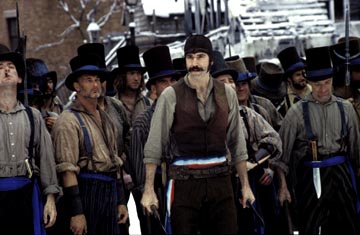
Movie Review: Gangs of New York

Of all of the stunning images from "Gangs of New York," one that sticks out is a shot that starts off on street level, and continues to go higher and higher until the 19th Century style buildings become the shape of the island of Manhattan. Here is a city that, over the years, I've grown to know and love. Here it is, in a form like we've never seen before.
"Gangs of New York" is Martin Scorsese's latest vision of the mean streets of his beloved New York. However, it takes place 100 years before the days of "Mean Streets" and "Taxi Driver," during Civil War ravished America.
The film starts off during a vicious gang war in 1848. Amsterdam Vallon (Leonardo DiCaprio) is the son of respected Irish immigrant Priest Vallon (Liam Neeson). On the opposite side is Bill 'The Butcher' Cutting (Daniel Day-Lewis). Bill is the glass-eyed son of a Revolutionary War soldier who gushes with patriotism. He's known as The Butcher not just for his day job, but for his weapon of choice.
As tensions rise between the Irish and the so-called 'Natives,' Bill murders Priest. Many years later, Amsterdam returns to a corrupt, Boss Tweed ruled Five Points and seeks revenge.
"Gangs of New York" shows Scorsese's recent fascination with American culture wars, as this film can be seen as something of a counterpart to his recent "The Departed." However, this film explores the roots of American diversity. It's about the earliest days of bigotry, much of it rising from immigration. In a way, much of the situations and dialogue sound frighteningly similar to the current national conversation on immigration.
Adding on to this is the near accurate version of history portrayed. While Hollywood will often portray history through a myopic lens of clean precision, Scorsese takes no shame in showing the filth, the blood, and the anger that shaped this era. Extra special attention is paid to the stunning sets. At times, it can distract from actual plot depth, but it definitely helps raise the story's level of believability.
Of course Scorsese's direction is excellent, but what stands out most is Day-Lewis' performance as Bill the Butcher. He is truly the best actor of this generation, and the carrier of the method torch. He steps into the character and makes him both a blood-thirsty savage and a patriot feeling betrayed by a country he helped defend. He may be racist, but his feelings can be understood. Not to mention, all he has to do is sharpen a knife, or just squint his eyes to become the most intimidating presence in the film. He basically steals all chance for any other actor in the film to shine.
Now, back to Scorsese. What makes Scorsese one of the great directors of cinema is that he knows how to handle violence better than any other director. Of all of his films, "Gangs of New York" may be his bloodiest. While most directors might show someone being stabbed and barely show the consequences, Scorsese slows things down and allows us to see the horrible, dehumanizing consequences of each kill. Later, after another major battle, the cobblestone streets turn into a red river. To Scorsese, violence isn't something to cheer on or admire, but rather something to be sickened by. Meanwhile, the aerial shots of the war dead are reminiscent of the sprawling images of the dead in "Gone with the Wind."
Upon its release, "Gangs of New York" divided audiences right down the middle. I believe it is a minor masterpiece; it doesn't reach "Goodfellas" or "Raging Bull" heights, but its certainly no sign of a Scorsese downfall either. The film runs over two and a half hours yet races by as Scorsese explores his favorite themes of honor, religion, and family. Like in any Scorsese film, the backdrop, cinematography, editing, and score of "Gangs of New York" is extremely well detailed and masterful. They portray the chaos of the era in the same way that each room in "Goodfellas" distinguished when exactly Henry was doing well or doing poorly. And while some have criticized that too much is covered at once, it all serves to cover the chaos.
Part of the problem could be in the story itself. While Scorsese at first creates the interesting idea that while Bill hated Priest, he had a deep respect for him. Once the conflict between Bill and Amsterdam arises that inexplicably seems to disappear from the film together with little explanation. Many scenes also seem pulled right out of the revenge film playbook. For example, the scene where Amsterdam saves Bill's life so he can later murder Bill himself is pulled straight from "Once Upon a Time in the West." A little clarification is never a bad thing.
But, these are just minor flaws. Overall, "Gangs of New York" exceeds its epic counterparts (mainly "300") in creating a vision of the past that's exciting and fascinating without actually losing a grip on the history part. It's a beautifully made history lesson about the birth of a nation and a bitter love letter to a city that spawned one of the greatest directors of all time.


Tuesday, November 3, 2009

Movie Review: Zombieland

There is a little, important secret of horror filmmaking I've been picking up on lately. That little secret is that less is more, that what we don't see is scarier than what we actually do see. Even though much blood and guts is spilled in "Zombieland," much is still left up to the imagination. This helps keep the film from being wannabe shlock to a totally satisfying horror satire.
"Zombieland" takes place in a post-apocalyptic Earth, long after a virus has turned most humans into cannibalistic zombies. The world has now become a Darwinian society, where all you need are a few basic skills to get by. One of those people lucky enough are Columbus (Jesse Eisenberg). Columbus is a scrawny, awkward college student who manages to get by unscathed because he's so used to loneliness.
While trying to reach his parents in Ohio, Columbus meets the tough, potty-mouthed, yet ultimately tender Tallahassee (Woody Harrelson). As they head east, they meet two con women: Wichita (Emma Stone) and Little Rock (Abigail Breslin). The rest of the plot mainly consists of them traveling cross country, searching for safe haven as Columbus begins to fall for Wichita.
As you'll notice, each character is named after a different city. They each name themselves after the destination they are headed to, whether it still exists or not out of confidentiality reasons. It seems kind of ironic that they want their names to be secret though, as they end up becoming something of a family in the end.
In my introduction, I made the film seem like too much of a pure horror film. That, it isn't. I only felt frightened at a few moments in the film, but then again, "Zombieland" was meant to be a satire, and not a horror film. That doesn't mean it's not directed like a good horror film though. Take the convenience store scene. The most brutal death involves Tallahassee, a zombie, and a pair of hedge trimmers. We don't see what exactly the trimmers do, but we do see them slide across the floor, covered in blood. It's inferring what happened, rather than actually seeing what happened, that challenges the viewer, builds suspense, and just makes it even creepier to ponder. However, "Zombieland" does show us a good amount of graphic blood and guts. However it's much more sparse than you might imagine, and it mainly happens at the way beginning. It's almost like director Rubin Fleischer's way of saying "there's the gore. Happy now? Can we just move on?"
I can't forget that "Zombieland" is first and foremost a satire. Unfortunately, I'm not well-versed enough in the zombie genre to say whether or not "Zombieland" effectively both pokes fun and pays tribute to the popular genre. However, the film may also be a satire of the horror genre in general (I picked up a reference to the banjo scene in "Deliverance"). I could spot even smaller possible satirical spots. Some of them could even be the more predictable moments of the film, possibly mocking how formulaic the genre has become.
The humor of "Zombieland" is buoyed by its two central performances. While it might be cool at this point to bash Eisenberg for playing the same character he played in "The Squid and the Whale" and "Adventureland" I'm going to go against the tide and say he gave a good performance because I like him and well, if someone is good at playing a certain personality, why shouldn't they be allowed to keep playing it?
Mainly, Harrelson's performance as Tallahassee steals the show. The writers give him a few great lines ("That'll do, pig"), and he does such a great job at delivering each one. Harrelson plays Tallahassee slightly like Mickey from "Natural Born Killers," if Mickey had a soft spot and a love for Twinkies.
Stone doesn't bring a huge amount to the table, but she doesn't really detract from the story at all either. Breslin, however, does a great job with the material. After this and "Little Miss Sunshine," she proves that she can handle more adult material better than most girls under 18 [Editor's Note: Let's say for example, Hannah Montana, who'd I'd love to see be eaten by zombies]. The film also includes an extremely random, yet hilariously and even refreshing cameo. I dare not give it away here; I don't want to ruin the fun for you.
"Zombieland" isn't perfect. It's short and it isn't the first zombie satire ever made (there's also "Shaun of the Dead" which, for the record, I still haven't seen). But why did I like it so much? Mainly, its 81 minutes of pure, blissful, escapism. It's the kind of escapism that will draw you out of reality and further and further into the world of movies. This isn't a Seltzer-Friedberg satire, it's the kind that has a deep knowledge, and even a deep respect, for the subject its consistently mocking. Not only that, but it stands as a comedy in its own right, with its own, original jokes, as well.