Showing posts with label Alexander Payne. Show all posts

Thursday, December 5, 2013

Movie Review: Nebraska

Image via Buzzsugar
Watching a director who has always directed their own writing suddenly bring somebody else's vision to life is always interesting. "Nebraska" marks the first occasion that Oscar winning writer Alexander Payne has directed a screenplay written by somebody else. Maybe the fact that it takes place in his beloved home state helped out a bit.

"Nebraska" marks Payne's first foray back into his home territory since 2002's "About Schmidt." However, it takes some time to get there. "Nebraska," like "Fargo" and "Chinatown" before it, are about more than the setting that their titles suggest. "Nebraska begins in Billings, Montana, the current home of the Grant family. Woody Grant (Bruce Dern) is the patriarch of the family, whether he is aware of it or not. Woody is a sad man living a sad life. He walks with a slouch and acts like he never wasted any potential because he never had much to begin with.

Sunday, November 10, 2013

My Most Anticipated Releases of November 2013

Nebraska

Alexander Payne has been on a hot streak basically since the beginning of his career. After "Sideways" and "The Descendants," "Nebraska" brings the director back to his home city of Omaha for what seems like his turn even further into dramatic territory. Plus, Will Forte has a shot to show his dramatic chops (I know that they are there) and generally awesome person Bob Odenkirk gets a big role [Note: Saul Goodman was supposedly relocated to Omaha at the end of "Breaking Bad." Hmmm...]. For great, little character-driven stories and perfect dark humor, Alexander Payne never disappoints.


The Hunger Games: Catching Fire

I have yet to read any of the novels in the "Hunger Games" series, but I was a big fan of the first movie, which was a thoroughly entertaining dystopian blockbuster. Since I have no background knowledge of the story, I am excited to see where "Catching Fire" brings the story next. Also, this will likely only increase my love for Jennifer Lawrence. Let's just hope that the baboons that I saw in one of the commercials are less ridiculous than the giant mutated dogs from the first installment.


Oldboy

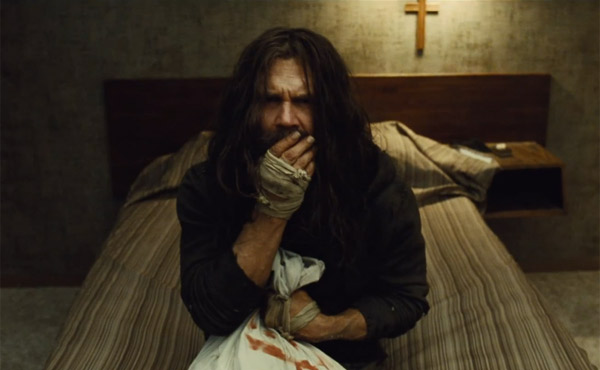
Ever since the moment I heard that Spike Lee was directing a remake of "Oldboy," I had no clue what to make of it. Why mess with Korean perfection? Could anybody ever recreate the pure shock of the octopus or hammer scenes? Still, I can't help but be more curious than angry about this remake. It has a stellar cast (Josh Brolin, Sharlto Copley, Samuel L. Jackson), and its easy to forget that outside of his often annoying media presence, Spike Lee is an incredibly talented director. Let's just hope this is more "Inside Man" than "Miracle at St. Anna."


No Country For Oldboy: Josh Brolin, who looks like he's auditioning to play Bruce Wayne stuck in the pit in "The Dark Knight Rises."

Monday, November 21, 2011

Movie Review: About Schmidt

It's almost 5 o'clock on some weekday and Warren Schmidt (Jack Nicholson) is on his last day of work before retirement. He's not so much paying attention to the paperwork on his desk, but rather for the very second that the clock strikes 5 PM and he's a free man. Then again, this was probably what every single day of work was like for him.

I think it would be a gross generalization to say that Warren Schmidt, the titular character of "About Schmidt" is no different from me and you, as there are many things that make me and you different. Rather, he begins the movie with no unique characteristics to establish him. He is vice president of an insurance company, working in a blank office in a plain, white skyscraper. Later, we will find out this was never the job he hoped to end up with.

Warren then goes home every day from work to a wife (June Squibb) he doesn't think he loves enough and a daughter (Hope Davis) who is marrying a deadbeat (Dermot Mulroney). The Schmidt household is a picture of lost potential.

Warren's life post-retirement has come down to a single Winnebago, the one he will drive cross country to his daughter's wedding. But Mrs. Schmidt suddenly, inexplicably, drops dead. This drives Warren into a second, even worse rut. But still, he must embark on that cross country road trip. Most say that long trips are best made with a companion. Well its a long road to Denver, and the only thing accompanying Warren are his thoughts.

"About Schmidt," like just about every other Alexander Payne movie, boils down to a road trip. While his films are usually about how friends or family resolve their differences on the road, making Warren go it alone shows that this is truly a film about a man who doesn't only need to redeem himself in the eyes of his family, but rather he must redeem himself in his own eyes. That's why when he begins writing letters to a boy he adopted from Africa, it sounds a lot like he's talking to himself.


"About Schmidt" certainly isn't Payne's best film. No, that honor still belongs to the twisted "Election." Yet, it captures an essence and a feeling that all of his films try to convey better than anything he has ever done. "About Schmidt" shows that the idea of America lies on the road. This is a country of people who feel the need to explore, from the pioneers to Warren Schmidt. This might sound like too much of an overanalysis but once you see this movie, it'll make sense.

"About Schmidt" shows in finest form that Payne and his frequent co-writer, Jim Taylor, know how to write natural sounding dialogue like few others working today can. The conversations feel colloquial yet relatable. No matter what, "About Schmidt" always gives off a warm, welcoming vibe, even when the characters act totally detestable.

Usually, a lone road trip would seem dull, and more like in-between time between big scenes rather than an entire movie. But Payne makes Schmidt's trip a deep, introspective one. While most road trip stories are interesting for what the characters see, this one is most interesting for who our character meets along the way, and the moments they all share together. There is something about the kindness of strangers that can make someone want to tell them anything. Or that is, if you don't feel comfortable saying anything to your own family.

I said it once before in my review of "The Descendants" that Payne can get established actors to go totally against type, and deliver some of their finest work. Jack Nicholson's most familiar character is a loud, outcast rebel. In "About Schmidt," he plays someone facing the consequences of a life of not taking any risks. It is a quieter performance than we are used to seeing from him. He unlocks something in the character that no other actor could in that he takes someone who is so plain and unextraordinary and makes him vibrant and extraordinary. Then, when he finally realizes how little time he has left, and how much of life there is to enjoy, his revelation feels earned rather than contrived.

For that main reason, the ending of "About Schmidt" feels right when it could've felt wrong. I am not saying that "About Schmidt" is going to change your life, as that is not the point of it. Rather, it might just make you want to look around, appreciate where your from, and then do something you wouldn't normally do. How often does that happen?

Sunday, November 20, 2011

Movie Review: The Descendants

Seven years ago, Alexander Payne dispensed a masterful romantic comedy called "Sideways" on us. Then, he all but disappeared, meaning that for seven long years theaters lacked the likes of Jack and Miles and Tracy Flick. Finally, Payne's fifth feature as a director, "The Descendants" has hit theaters, and it's the kind of film Payne must have been working toward his whole career to make.

Payne's early Omaha-centric films lent themselves perfectly to dark comedies, thanks to the always cloudy midwestern location. After checking out Napa Valley in "Sideways," Payne jumps across the Pacific to Hawaii for "The Descendants." This is Payne's darkest film. Despite it taking place in Hawaii, George Clooney's Matt King makes it clear from the very beginning that just because they live in paradise, Hawaiians are not "immune to life." This is not the sequel to "50 First Dates."

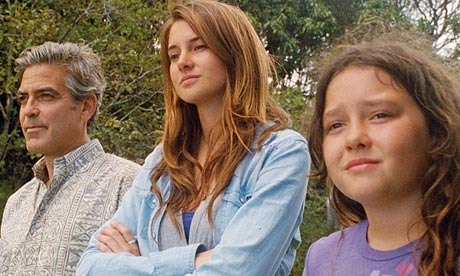
King is a lawyer, a land baron, and an absent father. Like most of the people around him, he wears a tropical shirt every day. However, rather than conveying relaxation, wearing these shirts just seem to convey stress. King comes home one day to find his wife, whom was always fond of extreme sports, to be in a coma after a boating accident. Not only must he care for someone who is on their deathbed, but also his daughters whom he barely knows.


His youngest daughter Scottie (Amara Miller) turns out to be a precocious mess without the guidance of her father. The oldest King daughter, Alexandra (Shailene Woodley), is a so-called problem child who surprisingly steps up to the plate once her mother isn't around. Matt's attempts to rekindle his relationship with his daughters is rough at first, but every minute of the film is a representation of him making a step in the right direction and becoming a better father.

Along the way, Matt finds out the nasty little secret that his wife was having an affair with a real estate mogul (Matthew Lillard), something that Matt's ineptitude as a husband might have forced her into doing. This all leads Matt to explore one big question: can you forgive somebody who is in a vegetative state?

Just as the eldest daughter must step up to the plate, so does Clooney in this challenging performance, and he definitely delivers, in one of the best roles of his career. Payne has a habit of getting his actors to go against character, and Matt King is the equivalent of Jim McAllister years after he decided to flee Omaha and Warren Schmidt before reaching old age. Clooney is best at playing characters who go through a crisis but this time, he gets a happier, or more accurately, uplifting, ending.


Clooney is an actor who usually gives very commanding performances. His performance in "The Descendants" is a different kind of commanding, the more quiet kind, the kind that could win him an Oscar. His character doesn't speak in monologues in front of a crowd but rather in long monologues inside of his head. Perhaps he is trying to reach out to someone that won't listen, or rather justify his own actions in the comfort of his thoughts. Either way, it sends the message that his neglect never came from lack of love. Perhaps a lack of understanding might be a better way to describe it.

"The Descendants" moves at a leisurely pace, making the good times better, and the tragic times more painful. Here is a film that wants its audience to wallow in both joy and sorrow. The audience is given ample time to get to know the characters, and soak in the fantastically convincing screenplay by Payne, Nat Faxon, and Jim Rash (yes, this guy).

"The Descendants" uses its Hawaiian locales to their full potential. While this film dispels the myth that Hawaii is a paradise, it doesn't shy away from the images of sandy beaches and towering green mountains from the Hawaiian stock photo factory. And why not? While Hawaii is a place filled with hardships like any other state in America, it is still a damn beautiful place to live.

At the core of "The Descendants" is a tragedy that causes many other tragedies. What this film does so interestingly is disconnect its audience from the tragedy. We never do witness the tragic accident that put Mrs. King into a coma, nor do we get to witness her being alive at all (there aren't even any flashbacks of her provided). It is this disconnect that ultimately makes "The Descendants" such an uplifting film, because in the aftermath of a tragedy, there is a certain unpredictable nature, as if there is nowhere to go but up. And that is exactly what the King family needs. And as an audience member, it'll make you love this film even more than you thought you could.